
The Wool Wire | August 21, 2026
Sleeping on wool in a heatwave, IWTO sets the record straight, a 1979 oral history of a Montana sheep farmer, and revisiting the numbers


News snippets from the wool world
Hello, my friends!
It's been hard to find a silver lining to the extreme heat that has been cooking so much of our planet this summer. But there is a very small and compelling glimmer coming out of the UK, so that's where we begin.
First the bad news: The UK is on track to have had the hottest summer on record—not the kind of statistic you'd think would prompt people to run for wool. And yet, according to our friends at Woolroom, sales of wool comforters, mattress toppers, and pillows was up by 39% over last July, while sales of wool mattresses spiked by an astonishing 126% in that same time period.
It's always hard to get people to think about wool when it's hot out, no matter how much we yell about the power of thermoregulation. But here, during the hottest summer on record, consumers have been doubling down on wool to keep them cool and help them get a good night's sleep. I see this as an educational victory worthy of celebrating.
 staff reports/contributors
Setting the record straight
Speaking of wool education, the IWTO has released a helpful new document that speaks to wool's environmental footprint. Some of you may recall something called the Higg Index, which was released several years ago by the Apparel Coalition in an attempt to help manufacturers make more informed buying decisions. That report gave polyester a much lower carbon footprint than wool, which made many people's heads spin, including my own.
Part of the problem was the methodology used to perform the life cycle assessment. Among other things, the Higg Index failed to take into account anything that happened after the garment left the store. We're talking how many washes and at what temperature, how long you can wear it before it wears out, what kinds of microplastics are released during washing and wearing, how much landfill waste it creates, the whole shebang.
Current life cycle assessment tools rank wool as more environmentally damaging than synthetic fibres derived from fossil fuels. The reason is methodological — and the IWTO Green Book contains a comprehensive response to this paradox.
It woke up the IWTO to the need for better data on the bigger picture of wool's environmental footprint—something that's fairly challenging to evaluate because wool is part of a much larger biogenic carbon system. It's not just a single factory-produced material, it's part of a far bigger picture.
That's the context for this new report, which I found very helpful. It gives tools to communicate facts better when talking to people. If you're in the mood to geek out, head over and get yourself a copy. They do make you fill out a form, but it's worth it.
 Jeannette Cook
A blast from the past
And speaking of talking, here's something fun from the Library of Congress's American Folklife Center and Veterans History Project. They retrieved from their archives an oral interview conducted in 1979 with a Montana sheep farmer Frank Barnum.
According to Johnson’s fieldnotes, Barnum was “well known in the area for running one of the largest and most successful sheep operations in that part of the country.” With the refrigerator rattling in the kitchen, the air conditioner kicking on just outside the window, and an unexpected visitor headed off by Barnum’s daughter Mary Alice, the two folklorists set up a tape recorder and began interviewing Barnum about his early life and his experience raising sheep in Montana.
If you don't have time to listen, you can still find lots of fun photos and excerpts from the interview in their write-up.
 Meg Nicholas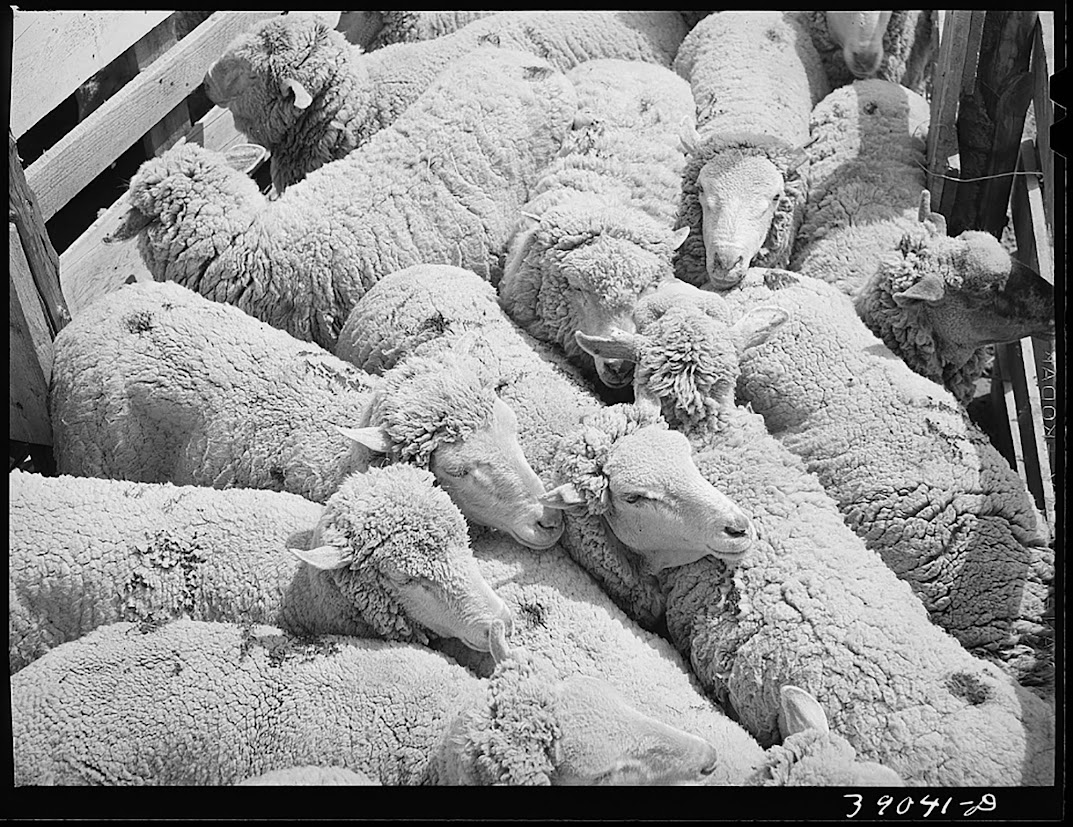
Re-evaluating the numbers
That oral interview got me thinking about just how far we've shifted since 1979. It's worth revisiting some numbers. I'm based in the United States so that's where I'm looking, but I suspect similar trends are unfolding in many parts of the world.
In 1979, the U.S. produced 100 million pounds of wool. Today, that number is down to 20.5 million. In 1979, about 70% of all our clothing was produced domestically, and today, just 3% is made here.
We bought less clothing in 1979, too. The average consumer brought home about 12 new items of clothing each year, spending 8% of their household budget to do so. Today, that number has skyrocketed to a whopping 64 to 68 articles of clothing (you heard me right), but at a cost of less than 3.5% of their household budget. We're buying more cheap stuff.
And what happens to that stuff? In 1979, a culture of wear-it-until-it-wears-out still prevailed. Today, reports suggest that at least half the time, the average American consumer will wear these items only three times before disposing of them. The contrast is rather dizzying and worth remembering as we move forward.
On that note, I'll let you go.
Thanks, as always, for your readership and your support.
Until next time,
Clara

The Wool Channel Newsletter
Join the newsletter to receive the latest updates in your inbox.