
The Wool Wire | October 2, 2026
A wool revival in Humboldt County, PETA's latest shenanigans and the intelligent voices speaking out against synthetics, grazing against fires and under panels, and a strange AI-generated story.

News snippets from the wool world
Hello, my friends!
The Wool Wire missed a week because of a family emergency that called me away to Arizona, where my 87-year-old mother had major surgery. She is healing well and I'm grateful to be back with you.
The unintentional pause turned out to be helpful in another way. It gave this next story time to play out and reveal an encouraging evolution where wool and public opinion are concerned.
You probably saw the news about a fashion industry CEO physically restraining PETA protesters who interrupted a COS fashion show at New York fashion week—and how he later resigned. (For the record, I do not condone laying hands on protesters. No matter how flawed their arguments may be.)
If you're reading this, you're already on Team Wool. You don't need me to explain why it's such a valuable material. I don't even recommend that you dig into the news at this point—but I did want to introduce you to two well-informed new voices that came forward to make powerful arguments for wool.
First is Hannah Teschler, founder of the Clean Clothing Coalition. She shared several posts to her 147,000 followers on social media, including this video about what she found when she dug into PETA's financial reports. I'm encouraged that public awareness of the tie between polyester and crude oil has never been higher.
Next is sustainable fashion author and podcaster Clare Press, who writes the Substack called Wardrobe Crisis. I love how she breaks down the madness of suggesting wool be banned, especially in the face of the petroleum industry's role in climate change. But she also underlines the importance of agricultural nuance in the wool conversation.
Making blanket statements about the sustainability of farming in general is fatuous. To state the obvious: it depends, on who is doing the farming, where and how. How can you compare wool grown by a shepherd in Iceland with wool grown by one of Australia’s mega stations like Rawlinna, or indeed a small hill farm in Tasmania run to protect declining native grasslands?
How indeed?
 Clare Press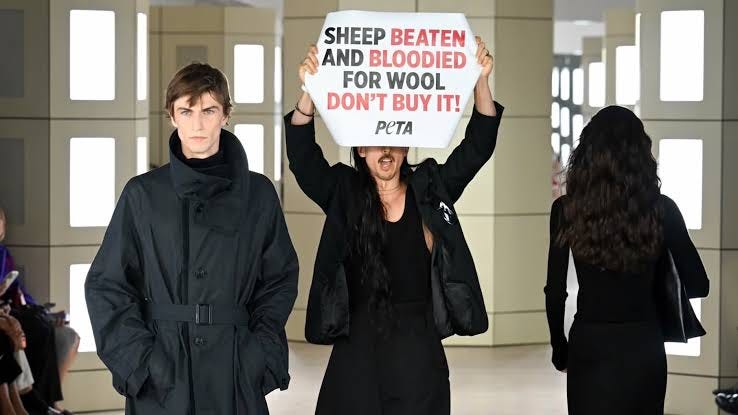
Grateful for grazers
Just a few days later, The New Yorker ran a beautiful and timely story about the use of prescribed grazing to prevent wildfires in California. It elevated the importance of grazing sheep and goats in a warming world, with a well-researched overview of how prescribed grazing is being used elsewhere. (The link is behind a paywall, but you might be able to sneak in like I did.)
 Ingfei Chen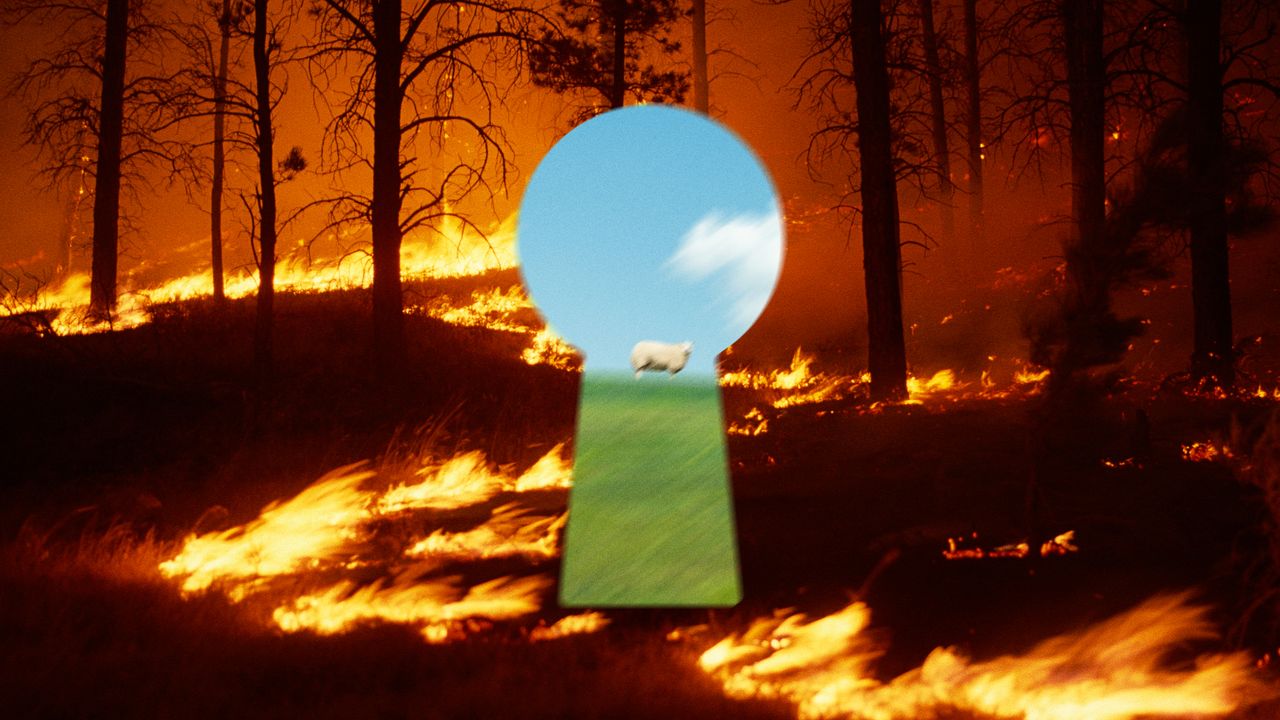
Home, home on the array
Speaking of grazing, the American Solar Grazing Association released a new video profiling a Minnesota couple making a living and a future for their family by grazing sheep on energy sites in Minnesota and throughout the western and central United States.
AI-yai-yai
The steady encroachment of AI is making it harder to know what's real anymore. Even our wool world is being touched in strange and baffling ways.
A few weeks ago, a story caught my eye that ticked all my boxes. It was about an independent outdoor gear site called Merino Gear Review that had purchased several garments listed on Amazon as 100% wool—and it alleged that an independent laboratory analysis came back that these weren't 100% wool at all. They all contained mostly Tencel and very little wool. Which wouldn't surprise me.
The article cited several funny-sounding brands I'd never heard of, with links to find them on Amazon. Turns out, none of the links in the article worked, and none of the brands was actually listed on Amazon. Or anywhere. So I went to Merino Gear Review and discovered that the domain contained only one page: that single story, whose author is listed as "Staff Reporter."
No masthead, no About page, no other information—just that single story, with a header designed to make it look like this was from a different publication, Textile Integrity Journal. Which also doesn't exist.
I'm still trying to figure out what the goal was. But ultimately, I'd like to think this story has two morals. First, if the prices for something wool on Amazon look too good to be true, they probably are. And second, any article that looks too good to be true...keep your wits about you and do some digging.
Littlefield says a lot
In the last Wool Wire, I told you about Melissa Littlefield's new book Reinventing Wool: How a Natural Fiber Survived the Synthetic Revolution, which we're reading in the Foundation Flock book group.
Melissa was just interviewed in The Long Thread podcast, and it's a great listen.

Lost and Found
Finally, here's a feel-good story from California's rural Humboldt County, where a new mill is helping facilitate a small-scale wool revival. It's called the Lost Coast Spinnery, and it's the first new mill in Humboldt County in 15 years. Since the story came out, they've successfully moved the mill to a bigger building with an electrical system that can handle the draw of all that mill equipment—thus clearing one of their biggest initial hurdles.
Accompanying the article is a fun video interview that includes a cameo from another sheep and wool figure, Cody Nicholson Stratton of Foggy Bottoms Boys.
On that note, I'll let you go.
Thanks, as always, for your readership and your support.
Until next time,
Clara

The Wool Channel Newsletter
Join the newsletter to receive the latest updates in your inbox.


